
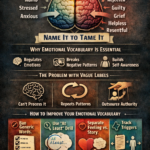
Over the time I have talked to people, I have realised this one particular thing. People explain a lot but they are never able to express what they want to say.
They feel so many things and when they open their mouth it is always about a story which is playing in the head which the other person rarely understands so they try to give more context. By the end the person just drifts off in their head and just nods in acknowledgement. This is even worse in relationships where one partner would just blast off making the other partner defensive ending up in a huge fight.
Overall what I am trying to say is that they feel something, but they can’t name it accurately. So they default to overused words like bad, anxious, stressed, angry, numb. These words are vague and sends abstract information. Vague language produces vague thinking. Vague thinking produces repeated suffering.
What Emotional Vocabulary Actually Is
Emotional vocabulary is the ability to differentiate internal states with precision.
Not:
- I feel bad
But:
- Emotionally unsafe
- Disappointed
- Rejected
- Ashamed
- Resentful
- Helpless
- Lonely
- Grief-stricken
Each of these words expresses a different cause, a different nervous system response which has motivated you to a different solution. Treating they without understanding what you really feel is like giving the same medicine for every illness.
I have a big problem when people say “I feel anxious all the time” usually aren’t anxious.
They are:
- Uncertain
- Hypervigilant
- Ashamed of wanting reassurance
- Afraid of loss of control
But saying anxiety sounds more acceptable and is like when I ask someone what chai/tea tastes like and they say Sweet.
Why Poor Emotional Vocabulary Keeps People Trapped
- You can’t process what you can’t distinguish
The brain regulates emotions by labeling them. This is neuroscience, not philosophy. Precise labeling reduces limbic activation. Vague labeling does not. - You repeat patterns without understanding them
If everything is “hurt,” you never see whether the pattern is abandonment, humiliation, envy, or unmet needs. - You outsource your authority
People with weak emotional vocabulary depend on others to tell them what they’re feeling: partners, therapists, spirituality, even social media. - You confuse emotions with identity
When emotions aren’t named, they become who you are instead of what you’re experiencing. I am insecure” vs “I am experiencing shame triggered by comparison.” One is a life sentence. The other is workable.
How to Improve Emotional Vocabulary (Practically)
1. Ban Generic Words
Temporarily remove:
- good / bad
- fine
- stressed
- anxious
- upset
2. Use the “At Least” Drill (You Already Do This)
Instead of:
“I did nothing right”
Ask:
“At least what did I do?”
This moves people from global self-attack to discrete emotional evaluation, which sharpens vocabulary.
3. Separate Feeling From Interpretation
“I feel ignored” is not a feeling.
Ignored is an interpretation.
Ask:
- What is the raw sensation? (sad, lonely, anxious, angry)
- What is the meaning I assigned?
This alone upgrades emotional intelligence fast.