
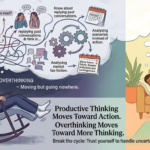
If overthinking burned calories, some of us would look like Olympic athletes.
You know the drill. You send a text to a person you like. Five minutes passed.
“Maybe I sounded needy.”
Ten minutes passed.
“Actually, I definitely sounded needy, what are they going to think about me?”
Thirty minutes later you’re mentally reconstructing the entire conversation, consulting imaginary juries, reviewing evidence from 2018, and somehow concluding that you’ve destroyed the relationship forever.
The other person, meanwhile, is probably taking a nap and knows nothing about the world where you live in.
As a psychologist, I’ve learned something interesting, intelligent people often assume overthinking is a sign of intelligence. It feels responsible. It feels thorough. It feels like we’re doing something useful. And they reinforce that thinking by complimenting themselves for predicting something in advance.
Unfortunately, feeling useful and being useful are not always the same thing.
Let’s talk about why our minds do this strange thing and why the brain sometimes behaves like an intern who refuses to stop sending unnecessary emails.
Why Humans Overthink
The first thing to understand is that your brain was not designed to make you happy.
I know. Terrible customer service as your brain was designed to keep you alive and not to keep you happy.
Thousands of years ago, survival favored people who noticed potential threats before they arrived. The person who thought, “That rustling in the bushes could be a predator,” survived more often than the person who thought, “It’s probably fine.”
Evolution rewarded caution.
The problem is that modern threats rarely look like predators.
Today the “bushes” are:
- A delayed reply
- A career decision
- A social interaction
- An uncertain future
- Something embarrassing you said ten years ago in school
The ancient alarm system is still running, but now it’s pointing itself at psychological threats instead of physical ones. Your brain treats uncertainty as a problem requiring immediate attention. And here’s the trap:
The brain mistakes thinking about a problem for solving a problem. Those are not the same thing.
People who know me know about my love for my rocking recliner. Imagine me sitting in a rocking recliner.
I am moving constantly.
I am exerting effort.
Yet I am going absolutely nowhere.
That’s overthinking in a nutshell.
The Real Psychological Reason We Get Stuck
Most people believe they overthink because they care too much or they can predict all the negative outcomes. Not exactly.
More often, people overthink because they have a difficult relationship with uncertainty.
Consider these two statements:
- “I don’t know what will happen.”
- “I need to know what will happen.”
The first creates discomfort.
The second creates obsession.
Overthinking is often an attempt to achieve certainty in situations where certainty simply doesn’t exist.
The mind starts bargaining.
“If I analyze this enough, maybe I’ll find the perfect answer.”
“If I replay the conversation enough times, maybe I’ll discover what they really meant.”
“If I predict every possible outcome, I won’t get hurt.”
The problem is that life refuses to cooperate. Reality remains stubbornly unpredictable. So the mind keeps running laps. It’s like trying to squeeze water from a stone while insisting that one more squeeze will finally do it.
Why Smart People Are Especially Vulnerable
This is the part nobody likes hearing. Intelligence can become fuel for overthinking. A powerful mind generates more possibilities. More possibilities create more scenarios which I call variables. More scenarios/ variables create more uncertainty. More uncertainty creates more thinking. An average worrier imagines three disasters. A highly intelligent worrier imagines thirty-seven disasters, four backup disasters, and a contingency plan for each.
It’s impressive. It’s also exhausting. Many overthinkers aren’t trapped because they’re incapable thinkers. They’re trapped because they’re exceptionally capable thinkers who never learned when to stop.
Has Overthinking Ever Actually Helped?
Let’s be fair. Thinking is useful. Reflection is useful. Planning is useful. Analysis is useful. Civilizations were built by people who thought carefully. The issue isn’t thinking. The issue is when thinking stops producing value and starts producing noise.
Here’s a simple distinction:
Productive thinking moves toward action.
Overthinking moves toward more thinking.
Suppose you’re considering a job offer.
Productive thinking might look like:
- Comparing salary
- Evaluating growth opportunities
- Considering location
- Speaking with trusted advisors
- Making a decision
Overthinking looks like:
- Re-reading the same information 47 times
- Imagining every possible future
- Researching for weeks
- Creating spreadsheets for your spreadsheets
- Remaining undecided
At some point, additional thinking stops improving the decision. It simply postpones the discomfort of choosing. The same applies to relationships. Reflecting on a conflict can improve communication. Replaying the argument 200 times while inventing alternate versions of what you should have said does not.
That’s not problem-solving. That’s mental fan fiction.
The Secret Reward Hidden Inside Overthinking
Here’s a counterintuitive truth. Overthinking often feels terrible. But it secretly provides relief.
How?
Because thinking creates the illusion of control. Action is risky. Decisions are risky. Conversations are risky. Thinking feels safer. If you’re busy analyzing, you don’t have to act. You don’t have to risk failure. You don’t have to risk rejection. You don’t have to discover reality. You can remain in the laboratory of the mind forever. Many people aren’t trapped by their thoughts. They’re protected by them. And protection is hard to give up.
Unconventional Ways to Stop Overthinking
Not because they sound good. Because they actually interrupt the machinery.
1. Make the Decision Before Solving the Anxiety
Most people wait to feel certain before deciding.
That’s backwards.
Certainty often arrives after commitment. Not before. Pick the restaurant. Send the email. Choose the option. Then let your nervous system catch up. The mind often interprets indecision as evidence that danger exists. A decision closes the loop.
2. Use a “Thought Budget”
Imagine you receive only ten minutes to think about a problem.
Not an hour. Not all day. Ten minutes. When the budget expires, action begins. We budget money because resources are limited. Attention is also a limited resource. Most overthinkers spend attention like drunk billionaires.
3. Ask One Brutal Question
Whenever you catch yourself spiraling, ask:
“What information am I expecting to appear that isn’t already available?”
Most overthinking collapses immediately. Because the answer is usually:
“None.” You’re not searching for information anymore. You’re searching for certainty. And certainty isn’t hiding around the next corner.
4. Predict the Disaster
Write down exactly what you think will happen.
Not vaguely. Specifically.
Then revisit it later. Overthinkers are often shocked by how inaccurate their predictions are. The brain develops humility when its forecasts repeatedly fail. And they fail far more often than people realize.
5. Practice Deliberate Imperfection
This one makes overthinkers deeply uncomfortable. Which is precisely why it works. Send a message that isn’t perfectly worded. Post something without rereading it twenty times. Leave a small task slightly unfinished. The goal isn’t sloppiness. The goal is teaching your brain that imperfection does not create catastrophe. Most overthinkers aren’t afraid of mistakes. They’re afraid of discovering that mistakes are survivable.
The Final Irony
Overthinking is usually an attempt to avoid pain. Yet it often creates more suffering than the situation itself. The awkward conversation lasts ten minutes. The overthinking lasts ten days. The uncertain decision lasts a week. The overthinking lasts six months. The embarrassing moment lasts thirty seconds. The replay lasts forever. The mind keeps promising that one more round of analysis will finally produce peace.
It rarely does.
Peace comes from a different source. Not from extracting certainty from uncertainty. Not from controlling every outcome. Not from finding the perfect answer.
Peace comes from developing enough trust in yourself that you can handle whatever answer reality gives you. And that’s a skill no amount of overthinking can ever build.
Only living can.